
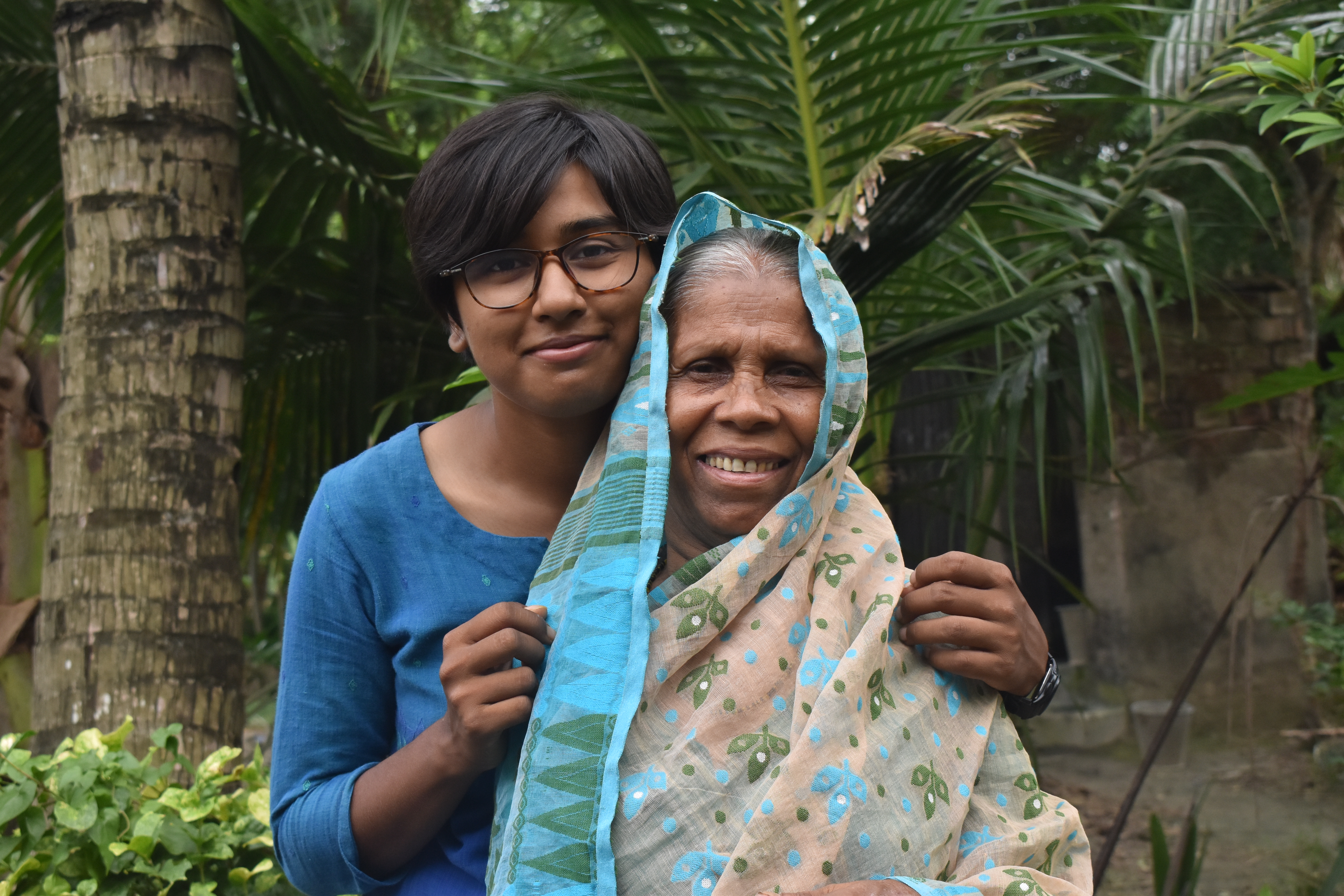
It doesn’t seem to matter whom I interview – uncle, grandmother, or friend. I cannot shake the feeling that I am extracting someone’s story. I feel coercive, exploitative. I go through the consent process. I tell them they can stop anytime. I ask if I can record – who would they want to listen to the recording? Just me? Family members? An archive? Should I delete it? Are they sure? Do they really know what they are doing? Have I made them feel as if they can’t say no? Even as I feel like the worst of thieves, a thief of someone’s life, I feel condescending as I ask them for consent, as though I am accusing them of not understanding what they are doing.
On no occasion was this clearer than the first proper oral history interview that I ever conducted. When I first met Boroma (eldest mother), I did not know her name, Bijoli Ghorai, and I did not know her story. It was 2021, and in the aftermath of cyclone Yaas, I accompanied a team from an environmental organisation to the Sundarbans – our objective was to assist people living in the South 24 Parganas in improving the water quality of the ponds that adjoined their households, a critical part of their lives, that had in many cases been ravaged by storm surges and saltwater incursion. Boroma’s son worked with the organisation; he lived in the town that we were working in and served as a point of contact to members of the community and to people living in neighbouring towns and villages. As we sat outside his house on a charpoy and chatted, an elderly but still very active lady wearing a saree in the muted shades of a Bengali widow came by to chat with us before returning to her work, perhaps in the house, perhaps in the nearby fields, or perhaps to her beloved cow that grazed placidly by the fence that separated the property from the narrow lane that led to the bazaar.

completing my master’s fieldwork. Picture taken by Tulika Goswami.
When I decided that I wanted to conduct the fieldwork for my master’s dissertation in the Sundarbans, the organisation I was working with suggested that I rent the spare room in the newly built pucca house that Boroma lived in with her son. I was there for nearly six months, bathing and washing my dishes and clothes in one of the household ponds where I had learned to conduct environmental quality checks, startled by the shimmery slide of a fish against my skin, learning about the rhythms of village life in a world that couldn’t be more different from my existence either in Kolkata or the many other places where I had lived. Boroma chatted with me as she single-handedly took care of a household that included a young grandson, child of a son who she had lost and who had shared the bedroom I now rented with his also deceased wife, her youngest son who helped a great deal with my fieldwork, a boisterous puppy, and a cow who was very popular with the local bulls. It might have been around that time that I asked her if I could call her Boroma instead of a Bengali word for Aunt – this word had newly entered my lexicon, and as someone who had only ever known nuclear families, I loved the sound of this word that described a matriarch. While her younger son primarily worked outside the house, Boroma went to the ration store, to get the rice puffed, to tend to the paddyfields, wash the clothes, gather vegetables, forage for wild edibles, catch fish, cook two meals a day, and offer prayers. Sometimes, in a more restful moment, as she sat by the cooking fire making rotis, she would tell me about the earthen house that had stood where there was now a house of brick and concrete, and the mice that had never quite left. She might note that once her son married and had someone to take care of the house for him, she could die in peace – in the meantime, she not only had to take care of her family, but she was taking care of me tooI helped out with the household work in what ways I could, and made sure never to leave my clothes or dishes in a state where she felt she needed to clean them, but I was always aware of how much weight this diminutive, deceptively frail-looking matriarch pulled – and of the life she had led. In those conversations I learned that she had spent her first years on Ghoramara, today known as the Sinking Island of the Sundarbans. She had been a climate migrant to the more ‘stable’ regions of the Sundarbans long before climate migration became a topic of household conversation the world over. In another fleeting moment, as she teased me for my fear of cockroaches after I screamed when one found its way into my bed, inside the mosquito net, she told me about the time she woke up in the middle of the night and found a cobra right next to her. When I think of the six months I spent living in the Sundarbans, my memories are often more of Boroma than they are of the birds I saw, the mangroves I walked through, or the seedlings I measured.

paddy fields range into the distance, and a narrow road leads into the main town. Right in front of the other window grows a mango tree that everyone tells me is haunted.
When I began working with the Archives at the National Centre for Biological Sciences and joined the Oral Histories of Climate Change pilot project, I initially thought I would like to travel to Ghoramara and interview someone who still lived there. In our training sessions, however, I came to realise that collecting an oral history is far more than a casual conversation, or even conducting an interview through a survey, questionnaire, or guide. It is a difficult thing to ask from a stranger. How do you tell someone that you have just met that you want to know everything about them? That they might share intimacies and process traumas with you that they have never shared with anyone else? No, better to ask someone that I already knew, someone who by now treated me not like a guest in her home, but as a family member who had their own part to play in the household when present. And she agreed to be interviewed, laughing slightly over the phone, asking who on earth would be interested in her life.
And yet I could not have anticipated how exploitative I felt when I began to go through the consent process with her. I had translated the form from English into Bengali, and I asked her if she’d like to sign it, but she said she would rather not. And so, I read out each portion of the form to her, and asked if she agreed, while I recorded it – verbal consent. And as I read out each part, and she replied with a soft ‘Hmm’, nodding, I found myself wondering what she made of this. Her story, her life, lived entirely in West Bengal, in a recording that would go to an institute in Bangalore, a place that she had never seen. People she had never met would listen to it, perhaps, or read the transcript, or write about it. What did she see herself agreeing to? Did she consider saying no, and if so, why didn’t she? Would she think about this conversation after I had left her home once again, carrying her story with me?

time annexed the pucca house. More recently, it has been replaced with a pucca kitchen of
brick and cement.
The interview itself lasted approximately an hour, and I was surprised by almost everything she told me. I had lived in the same house as this person for six months, knew when they woke up and went to sleep, how they took their tea, and what their relationship was with their children, children-in-law, and grandchildren. And yet the things on that afternoon, they told me about parts of their life I could never have guessed at, while omitting other things that in my researcher’s brain, I considered ‘relevant,’ things that would not make it into the recording. She started with her family’s stories – the ones from before she had even been born. Her grandfather, who died after being bitten by a snake, and was given to the river, like Lokhhindar in the Manasamangal, the religious poems that tell the tale of the goddess Manasa, mother of snakes. Her father, wading into the water with tears pouring down his face, as though he would follow him, until his family and neighbours pulled him back. How the family started off prosperous, with paddy fields by the river in Ghoramara, until the river began to take it all away.
“If you were to stand on the riverbank, she (Ma Ganga) would take you too.”
The family went to Sagar. There, the Block Development Office allotted them land, but it was land by the river once again, covered in mangroves, that her family had to reclaim and painstakingly make suitable for paddy cultivation. It would be years before they saw their first harvest, and in the meantime, they would struggle, often relying on the goodness of other villagers to have a good meal. (As a conservationist, I was trained to think of forest clearing first and foremost as deforestation, destruction, and here, the trees stood between a family and food security.) Eventually, Boroma met her future husband, through her father, and she came to her marital home. I knew the stories of her married life, the births of her children, her widowhood, and the loss of her middle son, but these did not come today.

entered the water is also where one sits and washes clothes and dishes. Storkbilled
kingfishers call to each other from the bordering trees, and damselflies throng the shallow
edges. Picture taken by Priyanjana Pramanik.
In interviews since, I’ve often heard people connect personal histories with larger geopolitical events – the death of a politician, or the start of a war. And yet, Boroma’s life story seems to me untethered to the histories of the mainland – but for one event. Her mother, she remembers, died around the time that Dhananjoy Chatterjee was executed.
And then, all too soon, it began to rain, and the interview ended unexpectedly as we rushed around to cover the bales of hay and bring in the clothes that were drying outside. I would not have a chance to continue that conversation as Boroma did not have a moment to spare for the rest of my stay with her. Oral histories are not always relaxed conversations that have space and time to bloom and unfurl; often, they are stolen from the work of the day. Later, as I transcribed the interview, translated it, and formatted the text to prepare it for the archival record, I still felt as if I had wrested the words from her, to use them to my own advantage, even as I wished I had asked her more questions, learned more, documented more. Her story. Boroma’s name is on the interview, and in the catalogue, and the archive, but I will be the one who has the report that I wrote about it on my resume. Her story, but it is now a part of me, as much as the shimmer of fish in the murky depths of the pond, or the taste of mangoes in the shade of a fruit-laden tree.
In some ways I feel like a Large Language Model, those AIs that we love to hate these days, trained on other people’s words. I use them to write my own. And yet, I feel the responsibility of the story that she entrusted to me. I will not misrepresent it. I will choose words carefully, just as I did when I translated the interview from Bengali to English, trying to transliterate, to bring back the feel of that conversation, the sensation of sitting on the ground with Boroma in the hallway of her house, as she remembered, sometimes laughing, sometimes crying, the memories that are imprinted on her mind.

tree was fruiting, I would carry back kilos of fruit freshly shaken from the tree. Sometimes, it
was mangoes. If nothing was fruiting, then it would be pickle or preserves. On this occasion,
I carried with me bundles of neem leaves (bitter but medicinal) with edible blossoms, and
pumpkin flowers to be deep-fried.
But I am not just a collector of these stories. I am a researcher, and a storyteller, and I produce written work. Stories are meant to be retold, and they take on a life of their own.
What would you like me to write for you today? A journal article? A book chapter? A short story?
Perhaps a blog post?
Priyanjana (they/them) studies the effects of human intervention on mangrove forests for their doctoral research at the University of Tasmania, Australia. They’re currently focusing on the use of the Ramsar Convention (an international agreement to protect wetlands) for the conservation of the Sundarbans. They also use oral histories to document the human side of conservation (and satisfy their insatiable curiosity about other people’s lives), and statistical methods to measure policy impact. They enjoy making science more accessible and writing ecologically correct fiction. Priyanjana splits time between Hobart, Tasmania, and Kolkata, West Bengal, and can usually be found near a pile of books and at least one cat.
4 responses to “The ever-extractive interviewer and an unfinished interview
Priyanjana Pramanik”
Dear Priyanjana, I read your blog with interest. I appreciate that you recognise the skewness in the power relation between the researcher and the interviewee. I believe the practice of getting a verbal consent is a procedural shield that evolved in response to the exploitative practices that have happened in medical research. Although Oral history intrudes into private space, these lived experiences are a treasure for policy formulation – a very powerful tool, especially where the voices of all Baromas are silenced with brutality. I congratulate you for bringing their voices forward. The Sunderbans should not end up as another weekend destination for the urban residents in search of insta reels of tigers. It needs to be respected as the residence of Baroma. Keep it up.
Thank you so much for reading and for bringing up those important points.
Beautifully written and raises questions around ethics that deeply resonates with me. Thanks, Priyanjana. Also love your photographs and the captions around those.
Thank you for those kind words, Sarmistha di!