
At the intersection of personal curiosity and academic pursuit, I undertook my first oral history interview—moving from theory at my college archive to practice through an internship with the 1947 Partition Archive. My positionality as a young undergraduate woman, conducting this for academic reasons yet drawn by inherited political sensibilities, shaped how I approached the task. The archive required interviewing a survivor, whether through direct or secondary memories. Hoping for a neutral, eloquent perspective, someone who would not simply echo my own thoughts, I unexpectedly found my mother’s maternal uncle volunteering with urgency: “You must consider me; I have a very vivid memory of the Partition and how it affected ‘us’.” That single word- ‘us’ became my hook. Who was this ‘us’? How would Partition be narrated through its lens? And where did I, the interviewer, belong within that collective? His sense of responsibility was palpable; he spoke not only as an individual but as a custodian of a shared legacy. Here, I first confronted what oral historians remind us repeatedly: the interviewer’s positionality is never incidental but a shaping force, often unnoticed yet present.

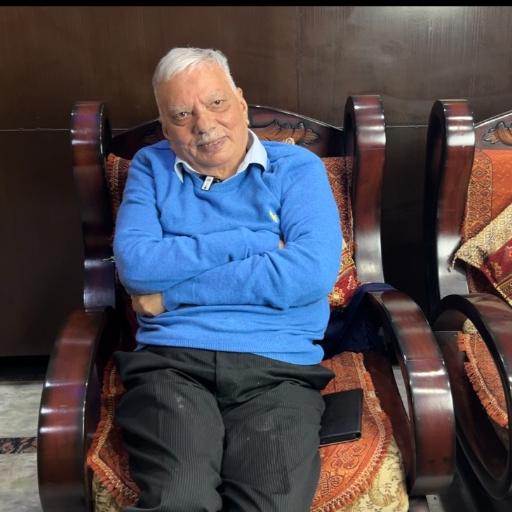
I chose him not just because of our familial ties but because he embodies the community I seek to understand better. At 84, Dr. Firoz Ahmad, a retired AMU chemistry professor was remembered in our family for his scientific curiosity, liberal values, and eloquence. His life has been devoted to academics, rooted in a family where education was paramount, and politics or governments rarely disrupted daily rhythms. He represents a stratum of society—educated, middle-class Muslims in northern India—where intellectual curiosity often outpaced partisan divides. What he would narrate echoed what I had grown up hearing from my parents about an ‘Aligarh Muslim’ identity—familiar, yet still distant enough for me to remain both connected and detached.
When I arrived at his home in Aligarh, on February 2025, he had been waiting since morning, dressed formally. His house reflected him—an academic, simple yet elite, the quintessential AMU professor. Stepping into the role of interviewer carried an ethical weight: how could I steer the conversation without letting my framework, or my personal attachment, overpower his voice? Conscious of this bias, I chose to listen far more than I spoke, letting silence guide when to probe.

Dr. Ahmad began with his roots, situating himself in a family where education and pluralism defined everyday life. His father—a scholar at Jamia Millia Islamia who later pioneered adult education—embodied a progressive spirit, while his maternal grandfather, linked to reformist schooling in Azamgarh, reinforced those ideals. This environment, neither rigidly religious nor sectarian, valued knowledge above dogma. “We spoke Hindustani, a blend of Persian and Sanskrit,” he recalled, a choice symbolizing the secular, composite culture his family cherished.
The conversation turned to Partition, the event that tested these values most sharply. Memory took center stage, echoing Lynn Abrams’ insight that oral history is shaped by episodic recall and interpretive framing. At six years old, Dr. Ahmad remembered it as a sudden rupture: “It was just one day,” he stressed. In Karol Bagh, Delhi, his family felt secure until a military officer hammered at their door—“You have two minutes, a mob is coming to burn your house.” Panic ensued: essentials gathered, a hurried escape onto a waiting bus, resettlement in Jamia Millia Islamia’s safety. Behind them, the home was reduced to ashes.
Yet his narration emphasized resilience over devastation. His father, steadfast, refused Pakistan’s lure, insisting their future lay in India. “We discussed India, not Pakistan,”. Ahmad chose to highlight resilience over trauma, perhaps to affirm his identity in a post-Partition India. As his relative, I felt the emotional pull—stories like this echo in our family gatherings—but as an oral historian, I noted how his narrative served a purpose: to counter stereotypes of Muslim disloyalty.
Dr. Ahmad’s recollections of leaders of the time carried a kind of community weight. He hadn’t met Gandhi, but remembered pressing against a window in 1947, catching sight of a frail man with a lathi at Jamia. “It was Gandhiji, visiting to inspire us.” Yet it was Nehru who stayed larger in his mind. As a school delegate, he saw him up close—“Chacha Nehru, our hero.” Perhaps Nehru felt nearer to their own hopes, less saintly, more human. “We talked about Nehru more; he shaped our dreams.” The “we” was telling. He wasn’t just speaking for himself but for what he called his community, I too had heard about at home. It felt less like one man’s memory than a collective one.
His school years at Jamia Millia Islamia came out almost like a dreamscape. He described those years as the “purest”—no sectarian divisions, no Shia-Sunni or Hindu-Muslim splits. “We played Holi, celebrated Diwali,” he smiled. “We thought only of the future—hard work, excellence.”

Aligarh Muslim University in the 1960s was a different reality. He told me, almost with disbelief, “For the first time, I heard words like Hindu-Muslim, India-Pakistan.” The campus still bore the scars of Partition. He admitted that as a young BSc student, “70% of students and teachers were pro-Pakistan.” He seemed uneasy recalling how his Jamia background marked him as too nationalist. But later, in the 70s and 80s, he thought things began to change. “Now, problems are seen as Indian, not Muslim,” he reflected.
What struck me most was how he narrated AMU through its moments of unity. He recalled a riot where his Hindu friend, Jagdish Mathur, defied his own family to stand with Muslim peers and protect the university gates. “It wasn’t Hindu saving Muslim,” he said softly. “It was Aligarians saving their home.” Listening to him, I realized AMU wasn’t a single story. Perhaps it was a mirror of Muslim anxieties and aspirations after Partition, always shifting. With a spark in his eyes, Dr. Ahmad told me: “There are so many Muslim countries, but none can have a university like AMU.” I found this striking—perhaps even contradictory—because earlier he had spoken of Aligarh’s pro-Pakistan leanings. Yet here, his pride felt undeniable. “Aligarh is a huge movement, bringing a silent revolution. It’s doing great service to the Muslim community and the country, boosting India’s secular image worldwide.” I think, in that moment, I could sense how deeply he believed in its role.
He refused to blame a single man or community. “The two-nation theory was given by Savarkar, followed by Jinnah.” And then came an analogy that stayed with me: “When the referee leaves the field, chaos reigns—who scores the goal is unpredictable.” It felt like his way of making sense of the bewilderment that Partition still carries.
At times, I felt his words grow sharper, almost as if he were answering accusations still alive today. He wanted to correct what he saw as distortions: “Not more than 10% even participated in elections. Ninety percent lived in villages, untouched by Jinnah’s call.” And when I mentioned the common claim that “80% of Muslims voted for the League,” he countered immediately: “It was only the elitist Ashrafi—zamindars, landowners, two or three percent.”
Perhaps what moved me most was his explanation of why so many Muslims chose to remain in India. “The masses,” he said softly, “followed the Maulvis, the Deobandis, the orthodox groups—who rejected Partition outright. The clergy had more influence than leaders or institutions.” I felt as if he was speaking on behalf of his ‘old community’, against oversimplifications, emphasizing class and clerical divides over blanket communal guilt.
This shift in his voice became a turning point for me. Suddenly, history wasn’t the neat narrative I had studied in Partition literature—it was refracted through his memories, his pride, his defenses. I had prepared with theories of elite politics and communal divides, yet in that moment they felt heavy, almost irrelevant. Oral history, I realized, demands something else: restraint. I couldn’t rush to fit his words into existing frameworks. I had to sit with the scatteredness, the contradictions, the sudden leaps.
It was unsettling, almost paradoxical—facts slipping into feelings, clarity dissolving into confusion. But perhaps that was the truth of it. The interview wasn’t about assembling dates and arguments; it was about witnessing the weight of a life lived in the aftermath, where memory and history blurred into one another.
His account moved between resilience and unease, celebrating the recoveries his community had made after Independence: creating heroes, debating identities, finding hope in the successes of AMU graduates who went on to serve as IAS and IFS officers. Discrimination, he insisted at first, was “largely rubbish”—what mattered was competence, effort, delivery. Even the Sachhar Committee Report, which he cited with precision, became for him less a marker of despair than of possibility, if only communities shed their own hesitations, especially in educating women.
Though I was reluctant to raise the subject, the archive required that I ask about the Babri Masjid. I could not have anticipated the chord it would strike. At first, he answered steadily, almost academically —until suddenly he wasn’t. “I’m a Jamia product from a nationalist background. My family never discussed Pakistan,” he said firmly. And then, almost without warning, his composure broke. Tears welled, his words faltered: “But today, deep in my heart, I feel my country has been stolen. I live in somebody else’s country.”
It was the most piercing moment of the interview. Here was a man who had built his life on science, reason, and debate, who dismissed victimhood, who resisted nostalgia. Yet, in that moment, the facade cracked. His truth emerged not in argument but in grief. For me, it was less about facts than about witnessing how history presses into a life, shaping not only memory but belonging.

Photo: Nadeem Babar.
And still, he did not end in despair. With a trembling voice steadied by conviction, he turned toward the future: “The best community in the world is Hindu liberals—it is their fight to protect India. Only Muslims destroyed Pakistan; only Hindus can save the idea of India.” He spoke of India’s singularity—the only country, he reminded me, where national holidays honor communities comprising less than one percent of the population. “India must be saved,” he said, “not just for itself, but for the world.”
Invoking his metaphor of resilience—“Man has a strange talent… even when his leg is amputated, he lives on”—I began to see the paradox of memory: its wounds remain, yet its spirit insists on continuity. Hayden White reminds us that history carries no inherent narrative; it is the historian who imposes form. But in oral testimony, the form is already alive, shaped by lived experience, tangled in contradictions, yet radiant with truth of another kind. Dr. Ahmad’s tears made this visible: not just “truth,” but his truth, demanding a place within the wider arc of history.
By the end, what remained with me was not simply an interview but a responsibility—a history that defied rigid categories, that entrusted me with the task of listening well. His quiet gratitude—“for making an insignificant man like me part of history”—reshaped my understanding of ethics in the archive: consent was not enough; fidelity to hope was required.
And perhaps that is what oral history ultimately offers. Not healing in the therapeutic sense, but the recognition that listening itself is an act—sometimes the only act—through which fractured worlds may find coherence. My quest to test the veracity of oral history returned me instead to a different truth: that in giving space to stories, one does not just collect history; one becomes part of it.
As I left Aligarh, his final words lingered: “The world will be saved when the masses claim the earth.” I carried with me a gentler reminder still, that sometimes, so much of the world could be healed, if only we learned to listen.
Acknowledgments
I am deeply grateful to the 1947 Partition Archive for granting me the opportunity to train as a certified Citizen Historian and for ensuring that this interview is preserved in the Stanford Libraries. I also wish to thank my professors at Jesus and Mary College, who first introduced me to oral history and encouraged me to engage with it meaningfully at the undergraduate level.
My sincere gratitude goes to Dr. Firoz Ahmad, whose generosity, patience, and candor made this interview both possible and deeply enriching. Finally, I would like to thank my family for their constant support—my mother, for connecting me to this history through her family, and my father, for assisting with the practical aspects of the interview.
References
• Abrams, Lynn. Oral History Theory. Routledge, 2010.
• Laub, Dori. “Bearing Witness or the Vicissitudes of Listening.” In Shoshana Felman and Dori Laub (eds.), Testimony: Crises of Witnessing in Literature, Psychoanalysis, and History. Routledge, 1992.
• Portelli, Alessandro. The Death of Luigi Trastulli and Other Stories: Form and Meaning in Oral History. SUNY Press, 1991.
• White, Hayden. Metahistory: The Historical Imagination in Nineteenth-Century Europe. Johns Hopkins University Press, 1973.
11 responses to “Echoes of Resilience: Meeting Dr. Firoz Ahmad
Fatima Nadeem”
A moving story from a survivor, told with feeling and honesty. Makes us rethink history as it is written. Individual stories reflect a more complex picture.
Thank you so much for your kind words. It really means a lot that the story resonated with you in this way. I agree, individual stories often open up new, complex ways of thinking about history that broader narratives can overlook. I’m grateful this piece could spark that reflection. Fatima Nadeem
A very well crafted piece. Your reflexiveness is interspersed seamlessly with the oral history account and key literature. One can see the work that went into it. (And I’m delighted to see you’re a student at JMC. I helped organise a collaboration between their History department and the 1947 Partition Archive in 2022. So this feels serendipitous to me!)
A beautify read. I hope you continue to write.
Thank you so much, I’m glad the reflexivity came through, it was something I thought deeply about while writing. And how serendipitous indeed! Since you were part of the JMC1 Partition Archive collaboration, I’d love to be in touch to explore something of that sort again this year. JMC would be honoured.
This is indeed a thoughtfully crafted and emotionally resonant article, seamlessly embedded within its historical context. We are proud of you.
Thank you so much, Ma’am. Your words mean the world to me. I truly owe this piece to the way you’ve always encouraged us to go beyond classrooms, to live history and engage with it deeply. I only hope this work does justice to the faith and effort you’ve invested in me.
Indeed a well-written piece, foregrounding the voice of the narrator, while underlining the idea that the interviewer also actively assists in the shaping of an interview: by listening. It is by listening that scholars can fill the gaps that exist in history-writing based on the written record. The Oral History Archive of JMC is very proud of you!
Thank you so much, Ma’am. Your words mean the world to me. I truly owe this piece to the way you’ve always encouraged us to go beyond classrooms, to live history and engage with it deeply. I only hope this work does justice to the faith and effort you’ve invested in me.
What a wonderful piece of writing! Every emotion was profoundly felt and expressed, and the narration is so seamlessly fit with the interview. So proud of you Fatima, this is such amazing work.
Thank you so much, Saanvi! Your words mean a lot to me. I’m so glad the emotions came through, and your support makes this journey even more special.
wonderful oral history!